
FAQ
Single-stair apartment buildings are a safe, well-established housing type that many cities and states already allow under modern building codes. This FAQ explains how they work, where they’re already legal, and how North Carolina’s approach aligns with national standards for safety and accessibility.
Frequently Asked Questions
Q.What is a “single-stair” apartment building?
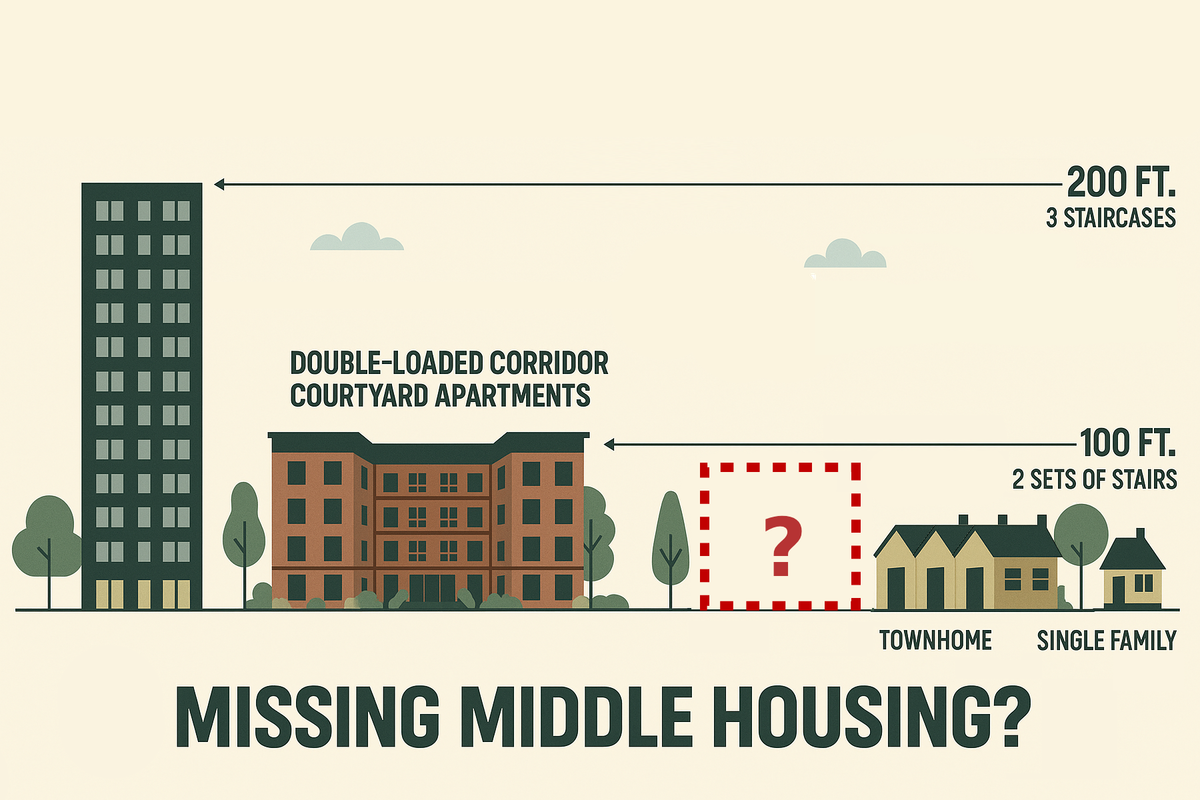
A single-stair apartment building is a small residential building where all apartments are served by one enclosed exit stair, rather than two.
These buildings typically include:
- 4–6 stories
- One protected exit stair
- An elevator
- A small number of homes per floor
- Full sprinkler coverage and modern fire-safety systems
Single-stair does not mean walk-up only. Most modern single-stair buildings are fully accessible.
Q.Do single-stair buildings have elevators?
Yes.
In nearly all modern single-stair codes, elevators are either required or strongly expected, especially for buildings above three stories.
Many adopted codes include:
- Elevator shaft pressurization, or
- Protected elevator lobbies, or
- Both stair and elevator treated as part of the fire safety strategy
This ensures:
- Accessibility for residents
- Safe firefighter access
- Redundancy for vertical movement during emergencies
Single-stair does not mean single-access.
Q.Does this mean taller or denser buildings everywhere?
No.
Single-stair reforms:
- Do not change zoning
- Do not override height limits
- Do not allow high-rises
- Apply only where apartments are already allowed
Zoning still determines where buildings can be built. Single-stair rules only affect how safely small apartment buildings are designed, often alongside elevators.
Q.Why do building codes usually require two stairs?
Two-stair requirements became common in the mid-20th century, before:
- Modern sprinkler systems
- Elevator smoke control
- Today’s understanding of fire behavior
At the time, stair redundancy was a simple safety proxy. Today, safety relies on multiple coordinated systems, including elevators designed to remain usable for emergency operations.
Q.Are single-stair buildings safe?
Yes. When built under modern codes, single-stair buildings meet strong life-safety standards.
They typically include:
- Full-building sprinklers
- Very short distances to the stair
- Fire-rated and often pressurized stairs
- Fire-rated corridors and self-closing doors
- Elevators with smoke protection measures
A Minnesota fire safety study found that features like sprinklers, compartmentalization, and reduced travel distance have a greater impact on life safety than stair count alone.
Q.Is North Carolina lowering safety standards?
No.
North Carolina’s proposal aligns with national practice:
- Similar height limits
- Similar unit limits
- Full sprinklers
- Fire-rated stairs and corridors
- Short travel distances
- Elevator protection requirements
The state is matching what other jurisdictions have already adopted safely.
Q.Where is single-stair housing already allowed?
Single-stair apartment buildings are already legal in:
- Seattle, Washington
- New York City
- Honolulu, Hawaii
- Nashville, Tennessee
- Austin, Texas
- Baltimore, Maryland
- Denver, Colorado
- Montana (statewide)
Research compiled by centerforbuilding.org documents how these reforms have been adopted through normal legislative and code processes.
Q.Why does this matter for housing affordability?
Requiring two stairs in small buildings:
- Increases construction costs
- Forces longer hallways and inefficient layouts
- Makes elevator-equipped small buildings harder to finance
Single-stair buildings:
- Use space more efficiently
- Support family-sized units
- Reduce per-unit construction cost
- Make small, elevator-served apartment buildings feasible
Q.What’s the bottom line?
Single-stair housing:
- Is fully accessible and typically includes elevators
- Is already legal and built across the U.S.
- Meets modern fire-safety standards
- Supports small, neighborhood-scale housing
North Carolina’s effort reflects a growing national consensus:
safe, accessible buildings can be designed in more than one way.